

Executive Summary & TL;DR (September 2026 Official Documentation Spec)
In autonomous terminal agents, each sequential request may re-include previous conversation and execution context. When Prompt Caching hits, the matching prefix is heavily discounted to Cache Read pricing ($0.20/MTok on Opus 5.5, a 95% reduction). Conversely, unexpected invoice spikes occur when cache checkpoints are invalidated—forcing large context blocks to be billed at standard input rates—compounded by high-cost Adaptive Thinking output tokens. Mastering multi-breakpoint preservation and context hygiene is the true governor of agent unit economics.
Chapter 01: Why Claude Code Costs Explode: Dissecting the Agentic Loop
The evolution of Vibe Coding has reached an industrial turning point. Beyond web chat windows and IDE inline completions, engineers now deploy autonomous terminal CLI harnesses (Claude Code, OpenAI GPT-6 Workspaces) operating with native operating system authority.
Engineers routinely delegate complex operations via natural language:
claude "Isolate the asyncpg deadlock across auth/session.py, align isolation levels with PostgreSQL, and verify the 5 failing E2E test suites autonomously."Practical Observation Upon receiving instructions, the agent scans repository paths, patches code, and triggers background test suites and Docker containers, iterating autonomously until tests pass. While modern flagship models support massive context windows up to 1M tokens, this reflects the model’s upper capacity limit rather than an endorsement that inflating context to 1M tokens is cost-efficient. The actual volume of ingested tokens swings dramatically based on file exploration depth and execution log accumulation. Without disciplined session hygiene, engineering teams frequently face painful corporate billing surprises—where an unmanaged background agent burns through hundreds of dollars on metered API keys in a single afternoon.
Three Core Drivers of Runaway Costs in Terminal Agents
- Repeated Context Processing and Cache Misses (The “Re-reading Tax”): Because API requests do not automatically persist session state across invocations, agents must re-transmit preceding context and tool logs in trailing requests. (In this guide, we metaphorically designate the computational overhead of repeatedly re-evaluating context as the “Re-reading Tax”.) When Prompt Caching functions properly, this segment is processed at 90% to 97.5% discounted Cache Read rates depending on the model (Sonnet 5: 90%, Opus 5.5: 95%, Fable 5.1: 97.5%); however, if cache invalidation occurs, massive token blocks must be re-purchased at baseline input prices.
- Adaptive Thinking Token Pricing Asymmetry: Modern reasoning models generate internal deliberation before emitting code. On Opus 5.5 and Fable 5.1, output tokens are priced 5x higher than baseline inputs ($20.00/MTok vs $4.00/MTok on Opus 5.5; $50.00/MTok vs $10.00/MTok on Fable 5.1). Extended thinking sessions accumulate substantial charges before visible code commits occur.
- Cascading Cache Miss Penalties: A discrepancy near the prefix header invalidates downstream checkpoints, billing subsequent context at standard input or fresh cache-write rates.
Chapter 02: Primary Claude Model Lineup and Platform Pricing
As of September 24, 2026, Anthropic’s primary model lineup and official pricing structure stand as follows, centered on the September 22 release of Claude Opus 5.5 alongside Claude Sonnet 5 as the operational workhorse:
| Model & Architecture | Official Specs, Thinking Control & Token Pricing |
|---|---|
| Claude Opus 5.5 (Flagship) |
Official Fact Released September 22, 2026. 1M Context Window, up to 128K Output tokens. Thinking Control: Adaptive Thinking is permanently active (thinking cannot be disabled; depth controlled via the effort parameter).Pricing: Input $4.00 / MTok, Output $20.00 / MTok. Caching Rates: 5-min Cache Write $5.00, 1-hour Cache Write $8.00, Cache Read $0.20 (95% Discount). |
| Claude Fable 5.1 (Deep Reasoning) |
Official Fact 1M Context Window. High-performance model engineered for demanding coding and knowledge workflows. Pricing: Input $10.00 / MTok, Output $50.00 / MTok. Caching Rates: Cache Read $0.25 (97.5% Discount). |
| Claude Sonnet 5 (Production Workhorse) |
Official Fact High-efficiency coding engine. Serves as a practical alternative for everyday development tasks, offering lower token rates ($2/$10) compared to Opus 5.5. Pricing: Input $2.00 / MTok, Output $10.00 / MTok. Caching Rates: 5-min Cache Write $2.50, 1-hour Cache Write $4.00, Cache Read $0.20 (90% Discount). |
| Claude Haiku 4.5 (Lightweight) | Ultra-low-latency utility model suited for file classification, simple linting, and lightweight subtasks. |
Billing Architecture: Subscription Seat Pools vs. API Metered Usage
In US engineering organizations, developers frequently experience confusion regarding authentication modes and invoice routing:
- Claude.ai Pro ($20/mo) & Max ($100–$200/mo) Seat Subscriptions: Authenticating via browser OAuth links Claude Code to personal or team per-seat allocations. Usage operates under rolling periodic rate limits (e.g., 5-hour messaging caps) rather than generating an immediate credit card line item.
- Anthropic Console & Cloud API Metering: Exporting a raw
ANTHROPIC_API_KEY(or routing through AWS Bedrock / Google Cloud Vertex AI) bypasses web seat caps and meters every ingested token directly against the organization’s Pay-as-you-go balance or corporate credit card.
This guide specifically addresses production metered environments, where cache misses and unmanaged context directly inflate enterprise cloud spend.
Critical Engineering Note: Adaptive Thinking Cannot Be Disabled on Opus 5.5
Unofficial forum tips suggesting export MAX_THINKING_TOKENS=0 are invalid under official platform specifications. On Opus 5.5, thinking cannot be disabled. Reasoning depth is modulated via the effort parameter. Cost governance relies not on suppressing cognition, but on tactical two-track model routing (Sonnet 5 for routine code, Opus 5.5 for architecture) and strict context hygiene.
Chapter 03: How Prompt Caching Operates: Key-Value Cache vs API Prefix Caching
A frequent misconception in technical writeups is conflating GPU-level Attention Key-Value (KV) Caching with API-level Prompt Caching. While related, they represent distinct architectural abstractions.
Internal Attention KV Cache
Maintains Key and Value activation tensors of processed tokens in GPU High-Bandwidth Memory (HBM) during auto-regressive generation. A hardware-level execution mechanism.
Anthropic Prompt Caching
Retains deterministic prompt prefix checkpoints at the API gateway layer, dramatically reducing ingestion latency and input pricing across sequential requests.
Prefix Checkpoints and Multi-Breakpoint Architecture (Up to 4 Segments)
Under Anthropic’s official prompt caching architecture, cached prefix tokens are evaluated from the start of the prompt. Tokens matching the deterministic checkpoint receive the discounted cache-read rate ($0.20/MTok on Opus 5.5, $0.25/MTok on Fable 5.1, $0.20/MTok on Sonnet 5), while trailing delta tokens are billed under standard input or cache-write terms.
Critically, Anthropic API supports up to 4 explicit cache breakpoints across tool definitions, system instructions, reference context, and conversation turns. Even if conversational history updates, preceding static segments (tool definitions and system instructions) continue to hit the cache successfully.
Caution: 95% Cache-Read Discount ≠ 95% Total Project Cost Reduction
While a 95% discount applies to cache-read input tokens on Opus 5.5 ($0.20 vs $4.00), 97.5% on Fable 5.1 ($0.25 vs $10.00), and 90% on Sonnet 5 ($0.20 vs $2.00), total invoices include initial 5-min ($5.00) or 1-hr ($8.00) cache-write charges alongside output tokens ($20.00/MTok). Net expenditure reductions typically settle between 60% and 90% depending on task duration and output density.
Chapter 04: The 5 Fatal Patterns That Invalidate Cache Checkpoints
Prompt cache hits require byte-for-byte exact matches across the segment prefix. Discrepancies invalidate subsequent prefix checkpoints for that turn:
- Dynamic Timestamp Injection: Appending per-turn timestamps or execution UUIDs into system headers shifts the token stream, invalidating all subsequent checkpoints.
- Tool Definition Mutations: Altering tool definitions or parameter schemas mid-session breaks caching across all subsequent context.
- Context Insertion Order Inconsistencies: Even with the identical set of files, if the order of context injection shifts across sequential requests, prefix checkpoints diverge, impairing cache reuse.
- Mid-Stream History Rewriting: Truncating or editing intermediate user or assistant turns invalidates the associative thinking cache chain.
- Thinking & Effort Configuration Shifts: Changing the
effortparameter mid-conversation alters resolved effort metadata injected into the prompt, invalidating the cache breakpoint. Keep thinking parameters stable within an ongoing session and guide depth adjustments via user prompt directives.
Chapter 05: Stop Guessing Cache Misses: Cache Diagnostics (Beta)
Anthropic provides the Cache Diagnostics (Beta) utility to isolate prefix divergence programmatically rather than relying on guesswork.
Programmatic Cache Diagnostics Mechanism
Cache Diagnostics inspects sequential API calls and flags the exact reason (cache_miss_reason) and missed input volume when cache hits fail. For US engineering teams instrumenting LLM observability via OpenTelemetry, Datadog, or enterprise proxy gateways, capturing these diagnostic payloads transforms prompt cache monitoring from opaque guesswork into deterministic FinOps telemetry:
// [Simplified Schema Structure Based on Official Documentation]
{
  "usage": {
    "input_tokens": 1250,
    "cache_creation_input_tokens": 15200,
    "cache_read_input_tokens": 0,
    "output_tokens": 820
  },
  "diagnostics": {
    "cache_miss_reason": {
      "type": "system_prompt_changed",
      "cache_missed_input_tokens": 15200
    }
  }
}
Chapter 06: Field Context Engineering Protocols
Across leading Silicon Valley engineering organizations, the consensus is clear: “Context Engineering has superseded Prompt Engineering.” In autonomous agent loops, system reliability and economic viability are dictated by how cleanly you curate what enters the context window:
- Concise, Focused
CLAUDE.mdGuidelines: Rather than treatingCLAUDE.mdas an exhaustive repository dump, restrict it to core architecture, test commands, and essential conventions to keep context lean. - Clear Role Separation:
.gitignorevs. Claude Code Permissions: While.gitignoremanages version control exclusion, Claude Code’s configuration (.claude/settings.json) and tool permission rules control agent path inspection. Configure both harmoniously to prevent unnecessary scanning of build artifacts (dist/) and raw datasets (*.parquet). - Context-Volume-Driven Session Lifecycle: Avoid arbitrary turn limits. Maintain clean 20K sessions across dozens of turns when prefix stability holds. If accumulated logs or expanded file injections cause the context to grow excessively relative to the task scope, committing milestones and splitting or compacting the session is the sound engineering protocol.
- Two-Track Model Allocation Strategy: Deploy Claude Sonnet 5 ($2/$10) for routine unit tests, boilerplate scaffolding, and straightforward bug fixes. Reserve Claude Opus 5.5 ($4/$20) selectively for multi-file architectural overhauls.
Chapter 07: Hypothetical Cost Simulation: Monolithic vs. Optimized Workflows
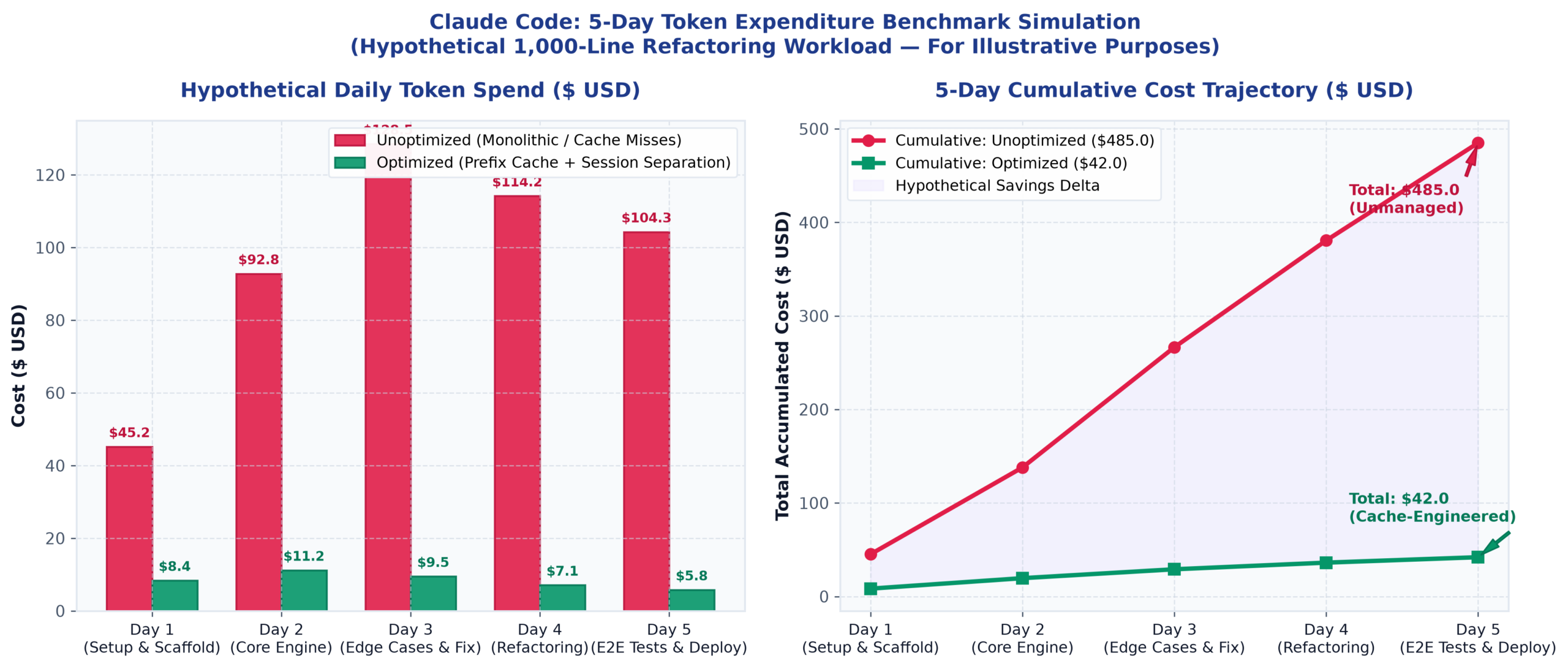
To illustrate the financial impact of disciplined context hygiene, we evaluated a hypothetical 5-day refactoring simulation encompassing a 1,000-line module rewrite, 35 unit test additions, and 45 sequential agent interactions.
Simulation Disclaimer
The following metrics represent an educational hypothetical simulation based on official model pricing formulas and modeled token volumes, not specific client billing records. Actual expenses depend on codebase topology and interaction count.
Cost Modeling Formulation & Parameter Breakdown
Total Cost = (Base Input MTok × $4.00) + (Cache Read MTok × $0.20) + (Cache Write MTok × $5.00) + (Output MTok × $20.00)
| Execution Scenario | Token Ingestion Volumes, Cache Ratios & Calculated Invoices |
|---|---|
| Scenario A: Unmanaged Monolithic (Single Long Session, 85% Cache Miss) |
• Ingested Input: 25.0 MTok (repeated codebase rescanning) • Cache Read (15% hit): 3.75 MTok × $0.20 = $0.75 • Cache Miss Input (85%): 21.25 MTok × $4.00 = $85.00 • Cache Write (5-min): 20.0 MTok × $5.00 = $100.00 • Cumulative Output (incl. Thinking): 15.0 MTok × $20.00 = $300.00 → Total Calculated Cost: $485.75 (≈ $485.00) |
| Scenario B: Engineering-Optimized (Prefix Preservation, Milestone Compaction) |
• Ingested Input: 8.0 MTok (targeted indexing & session clearing) • Cache Read (90% hit): 7.20 MTok × $0.20 = $1.44 • Cache Miss Input (10%): 0.80 MTok × $4.00 = $3.20 • Cache Write (5-min): 3.0 MTok × $5.00 = $15.00 • Cumulative Output (task decomposition): 1.1 MTok × $20.00 = $22.00 → Total Calculated Cost: $41.64 (≈ $42.00) |
| Key Takeaway |
Compound Optimization Effect: The reduction from $485 to $42 stems not merely from cache hit rates, but from a combined impact of (1) reducing total input bloat (25M to 8M), (2) pruning output tokens via task decomposition (15M to 1.1M), and (3) systematic session compaction. * Note: Cache Write MTok is not identical to total input tokens, but represents the cumulative volume of newly committed cache checkpoints over the period. |
Chapter 08: Comparative Benchmark: OpenAI GPT-6 Lineup & Cached Input
Production Cost Optimization Checklist
- Target Context Ahead of Execution: Explicitly scope required source files and directory subtrees rather than invoking global sweeps.
- Eliminate Dynamic Elements in Prefix: Ensure timestamps, execution IDs, and dynamic headers never precede static system and tool declarations.
- Preserve Tool Schema Immutability: Maintain rigid tool descriptions and schema parameter structures throughout session iterations without unnecessary shifts.
- Prevent Mid-Session Effort Shifts: Avoid mutating reasoning effort mid-stream to prevent invalidating active cache breakpoints.
- Compact Sessions on Excessive Context Growth: Commit milestones and reset or compact sessions once accumulated context bloats excessively relative to the task scope.
- Implement Two-Track Model Deployment: Route routine scaffolding, unit testing, and straightforward bug fixes to Sonnet 5 ($2/$10) before engaging Opus 5.5.
Official Fact OpenAI’s official API specifications present competitive pricing structures and reasoning capabilities across their corresponding tiers:
| Model Tier | OpenAI API Standard Pricing (Max 272K Input Tokens, Sept 2026) |
|---|---|
| GPT-6 Astra (Flagship) |
High-performance flagship model supporting Computer Use and complex coding workflows. Pricing: Input $10.00 / MTok, Cached Input $1.00, Output $50.00 / MTok. |
| GPT-6 Sol (Coding Core) |
Official Fact Released September 22, 2026. High-efficiency engine optimized for autonomous code generation. Pricing: Input $2.00 / MTok, Cached Input $0.20, Output $10.00 / MTok. |
| GPT-6 Luna (Lightweight) |
High-speed, low-cost utility engine. Pricing: Input $0.10 / MTok, Cached Input $0.01, Output $0.50 / MTok. |
| Architectural Synthesis | Claude Code excels in native OS terminal integration and deep architectural refactoring via Opus 5.5, while identical context hygiene and prefix caching principles apply across OpenAI’s API tiers (e.g. GPT-6 Sol Standard Cached Input at $0.20). |
Autonomous terminal agents do not succeed merely on raw model intelligence. The engineering discipline of curating context, defending prefix checkpoints, and auditing cache misses via Cache Diagnostics strongly governs both software quality and enterprise unit economics.
Official Documentation & References
- Anthropic Claude Opus 5.5 Overview & Specifications: https://platform.claude.com/docs/en/models/opus-5-5/overview
- Anthropic Platform Pricing Documentation (Opus 5.5, Sonnet 5, Fable 5.1): https://platform.claude.com/docs/en/about-claude/pricing
- Anthropic Cache Diagnostics (Beta) Architecture Guide: https://platform.claude.com/docs/en/build-with-claude/cache-diagnostics
- Anthropic Prompt Caching Guide: https://platform.claude.com/docs/en/build-with-claude/prompt-caching
- OpenAI Developers API Pricing (GPT-6 Sol, Astra, Luna Standard): https://developers.openai.com/api/docs/pricing
- OpenAI Developers Official Changelog (September 2026 Releases): https://developers.openai.com/api/docs/changelog